Shared memory, culture, and values
La Rochelle–Quebec: a long-standing history
Facing each other along the 46th parallel North and separated by the Atlantic Ocean, the city of Quebec and La Rochelle share a long-standing history. From the first settlers to the Francofolies festival, their bond has been woven through friendship, exchange, and mutual sharing. Let’s go back to the roots!
La Rochelle
The French Kingdom’s Canadian port
In 1608, Samuel de Champlain, born in the village of Brouage not far from La Rochelle, sailed up the Saint Lawrence River and founded a trading post that would become the city of Quebec. Sailors from La Rochelle were well acquainted with these seas, where they embarked on long fishing expeditions for cod around the Grand Banks of Newfoundland.
As early as 1629, the Company of One Hundred Associates, under the impetus of Cardinal Richelieu (the same who subdued La Rochelle), was tasked with populating New France in exchange for a monopoly on the fur and pelt trade.
La Rochelle established itself as the Canadian port of the Atlantic seaboard: it exported tools, clothing, weapons, tableware, salt, wine, spirits, and flour, and transported military equipment and troops.
Drawn by this steady traffic, migrants flocked to the Old Port: they boarded ships in search of adventure, to escape poverty, or to win royal favor. Sailors, the "filles du roi", merchants, artisans, and convicts, many from Aunis and Saintonge and other impoverished provinces of the kingdom, set out to populate New France, after a final prayer at the Church of Saint-Sauveur.
For over a century, ships left laden with souls and dreams and returned to La Rochelle filled with skins and furs, which were traded at premium prices, restoring the wealth of the ocean city that had been weakened after the 1628 siege.
Canadian cobblestones on rue de l’Escale?
It's an urban legend! Ships returning from Quebec laden with light cargoes of hides and furs needed ballast stones to maintain stability. Collective memory has kept alive the idea that some of La Rochelle’s streets were paved with stones taken from the St. Lawrence River. While science has somewhat called this story into question, the legend still holds firm… on the cobblestones of La Rochelle!
A partnership that still lives and breathes today
A shared story and common values
What binds La Rochelle to Quebec, far beyond history, is the resonance of shared values on both sides of the ocean:
A shared language: Quebecers are deeply committed to the French language, which they actively protect from the encroachment of English.
If La Rochelle is bold and rebellious, Quebec remembers! The spirit of freedom and independence that shaped La Rochelle’s past is also fiercely embraced by Quebec, which, like an indomitable village, continues to resist the English-speaking “invader”!
A tradition of hospitality and openness, in both a country and a city turned toward the horizon and the exchange of ideas and cultures.
A deep connection to cultural and human heritage, tangible and intangible, guardians of a living memory passed on across oceans.
A living and lasting bond
Quebec and La Rochelle continue to sail side by side. Their shared memory was officially sealed in 1984 with a twinning agreement, marking a mutual desire to build a strong and active partnership.
La Rochelle’s famous Francofolies festival found its echo in Montreal’s Francos, both celebrating French-language music on either side of the Atlantic.
Even some well-known La Rochelle businesses and institutions have ventured across the ocean to try their luck in La Belle Province.
🗨️ Good luck guessing which side of the Atlantic you're on if you say you're off for a drink at Les Enfants du Rock after a Francos concert!
The twin cities continue to foster numerous cultural, scientific, and academic exchanges, keeping their shared heritage alive.
In 2025, two artists-in-residence at the Maison des écritures (Parc Delmas) will follow in the footsteps of the pioneering women. Sarah Clément-Colas, a French filmmaker from La Rochelle, and Annick Lefebvre, a Quebec playwright, will collaborate on a portrait journal, a blend of fiction and reality, bringing to life the stories of the women from the region who left to settle in New France.
Where to see and experience Quebec’s history in La Rochelle?
Beyond the stories, the memory of the Franco-Quebec bond is etched into the streets, stones, and landscapes of La Rochelle. By following the Quebec Trail, visitors can discover emblematic sites that each tell, in their own way, the epic journey of the pioneers of New France.
Follow the Quebec trail
The Quebec Trail leads you through the architectural and urban traces of this shared past in La Rochelle. As you walk along streets named after those who helped build this strong bond, homes, facades, and shop signs reveal the commercial and human connections that have shaped the city.
Quebec remains etched into La Rochelle’s architectural memory — from François Perron’s shop to the Oratory, from the Natural History Museum to the Hôtel de la Bourse — and even beyond, in places like Esnandes, Aytré, Périgny, and Saint-Xandre…
On the Old Port and in the historic city centre
The Old Port: the historic departure point for ships bound for New France; the image of the Saint-Nicolas and Chaîne towers was the last glimpse of France for many migrants.
Saint-Sauveur Church: once the sailors’ parish, it witnessed the departure of many colonists, and houses a chapel dedicated to François de Laval, the first bishop of Quebec.
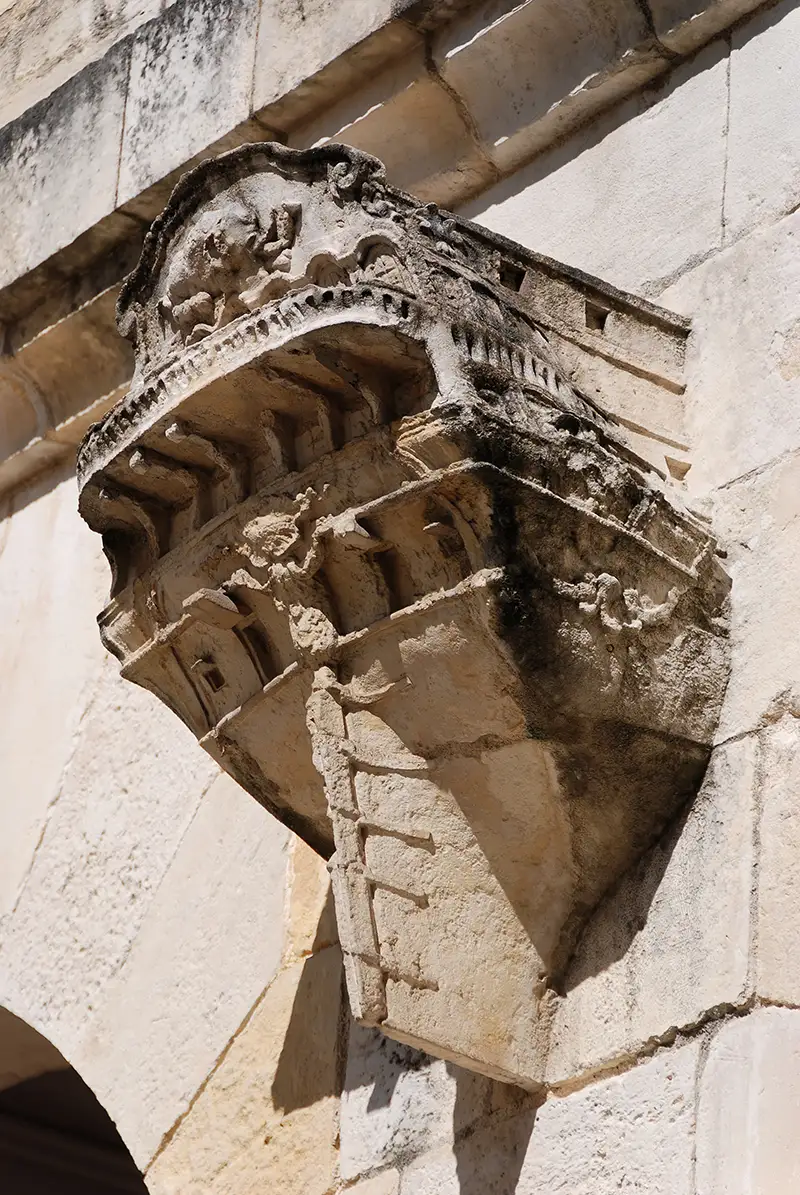
City Hall: its sculptures and coats of arms reflect La Rochelle’s commercial power and its role in Atlantic expeditions.
The shop sign “Aux plombs du Canada” (rue de la Ferté): a remnant of vital trade with the colonies.
Museums and sites of memory
The New World Museum (Rue Fleuriau): A must-see for understanding the exchanges between La Rochelle and the Americas, featuring a rich collection on New France.
The Fromentin Chapel: A former Jesuit college, from which many missionaries departed for Canada.
The Stock Exchange Building: An elegant structure adorned by Québecois sculptor Pierre-Noël Levasseur, bearing witness to the merchant networks of the 18th century.
In Parks and gardens
- The Cousins’ Garden (Charruyer Park): planted in 2008 with maple, cedar, and poplar trees from Quebec, in tribute to the families who left to settle New France.
In search of origins
In 2008, the planting of a dozen tree species from Quebec (red cedar, maple, grey poplar, honey locust...) commemorated the memory of the 450 founding families from the Poitou-Charentes region. Even today, 60% of Quebecers trace their roots back to Charente-Maritime!

Written by
Nathalie Maynadier