François and Benoit Durivaud
Moules Brothers, mussel farmers for 5 generations
Between Charron and Chef de Baie in La Rochelle, brothers François and Benoit Durivaud represent the 5th generation of DURIVAUD mussel farmers. What does their work involve? They raise and produce bouchot and rope-grown mussels in the Pertuis Charentais and the Bay of Aiguillon. Respecting tradition, these two enthusiasts carry on ancestral techniques while adapting them to new technologies. Meet these two guardians of the sea, the Moules Brothers, who live this family heritage as a true passion. After meeting them, you’ll never look at mussels the same way again!
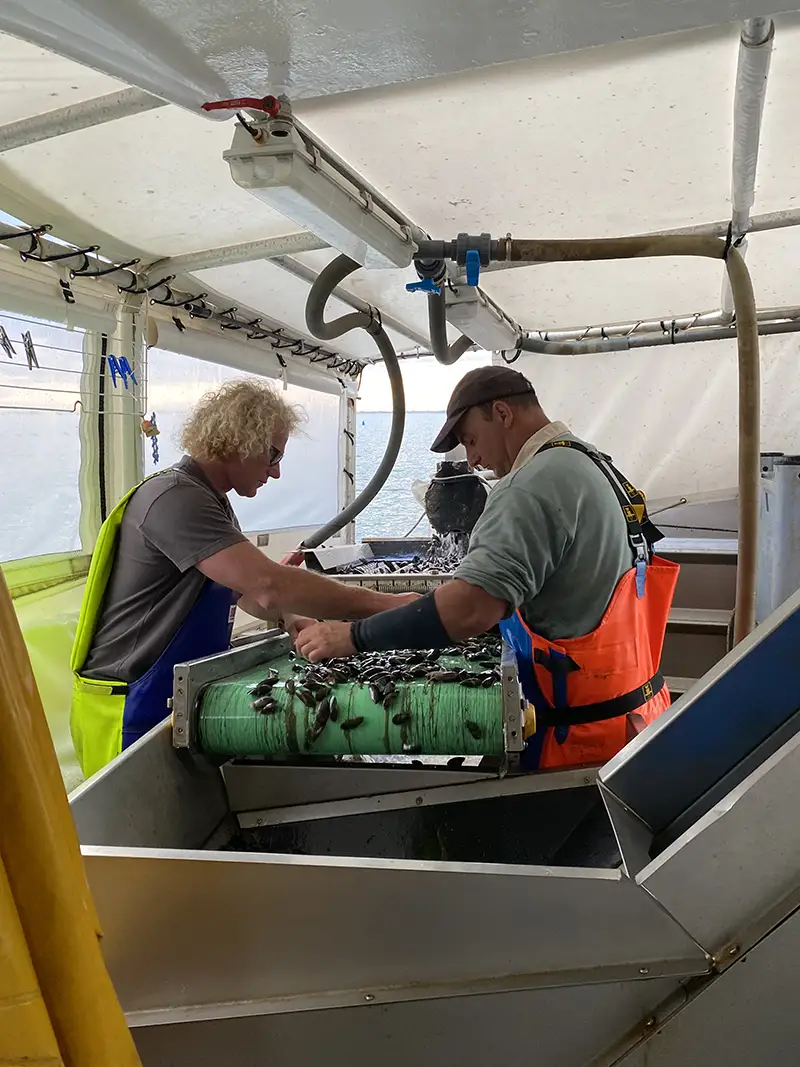
François & Benoit Durivaud
Mussel Farmers
Mussel farmers
A passion and a family tradition passed down through generations
🗨️When our great-grandfather Henri Durivaud drove his first bouchot posts into the Bay of Aiguillon, he could never have imagined that 100 years later, his passion would still be alive!
5th generation of mussel farmers: that’s something special! Tell us your story.
Benoit:
“François and I started out together in 1998 at the fishing port of Chef de Baie in La Rochelle. We had a mussel-farming boat stationed there and sold our mussels wholesale, straight off the boat.
Then in 2001, we left Chef de Baie to set up in a building in Marsilly.
But a few years later, in 2012, destiny called us back to our roots in Chef de Baie. We had the opportunity to share a shed with Morin, another mussel farmer.
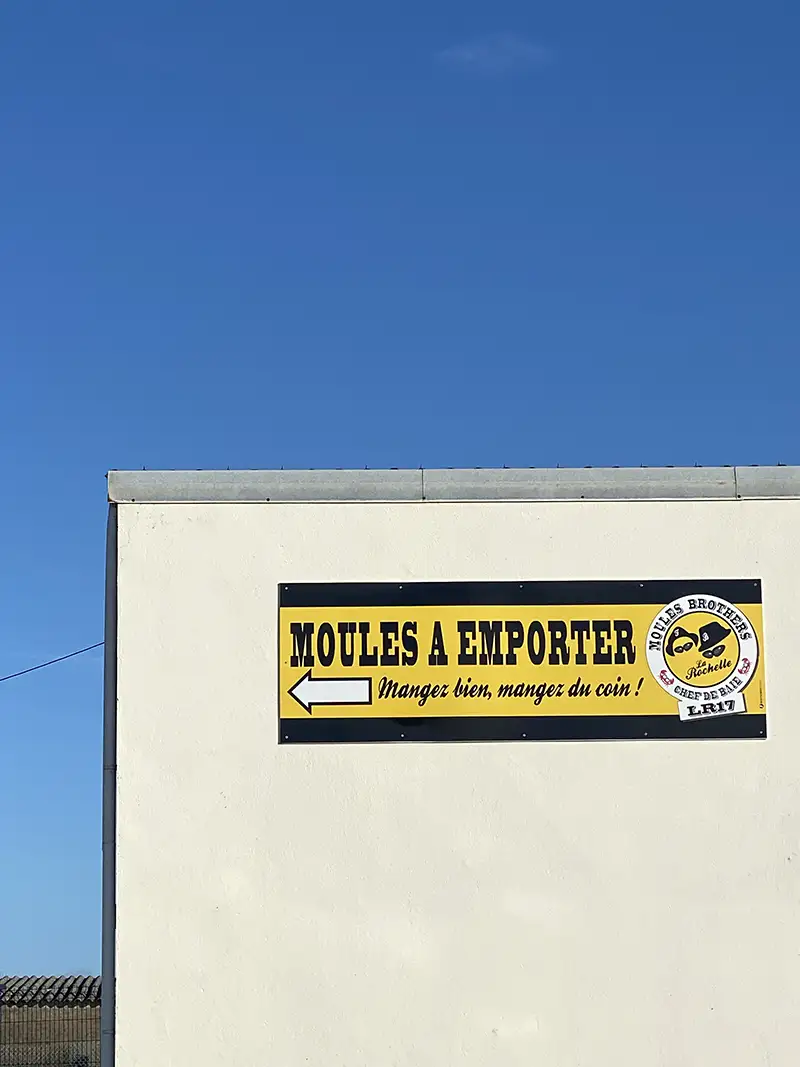
And in 2017, when an outfitting shed became available in Chef de Baie, we created Les Moules Brothers: a tasting venue and direct sales point for mussels, oysters, and other shellfish, which to this day remains an activity that extends naturally from the harvest of our mussels.”
Where exactly are your mussels farmed?
Benoît:
“We have two designations for our bouchot mussels, which correspond to their farming areas: between Île de Ré and the Vendée coast for the CHARRON designation; and in the bays of Yves and Fouras for the FORT BOYARD. While these two products are similar in their farming method, their fresh flavor, and their fine appearance, the CHARRON stands out with its deep black shell, whereas the FORT BOYARD tends to have a slightly yellow-iridescent hue.”
What does the bouchot technique consist of?
Benoît:
“The harvest of bouchot mussels is highly seasonal, but there is a precise technique and specific steps to follow throughout the year.
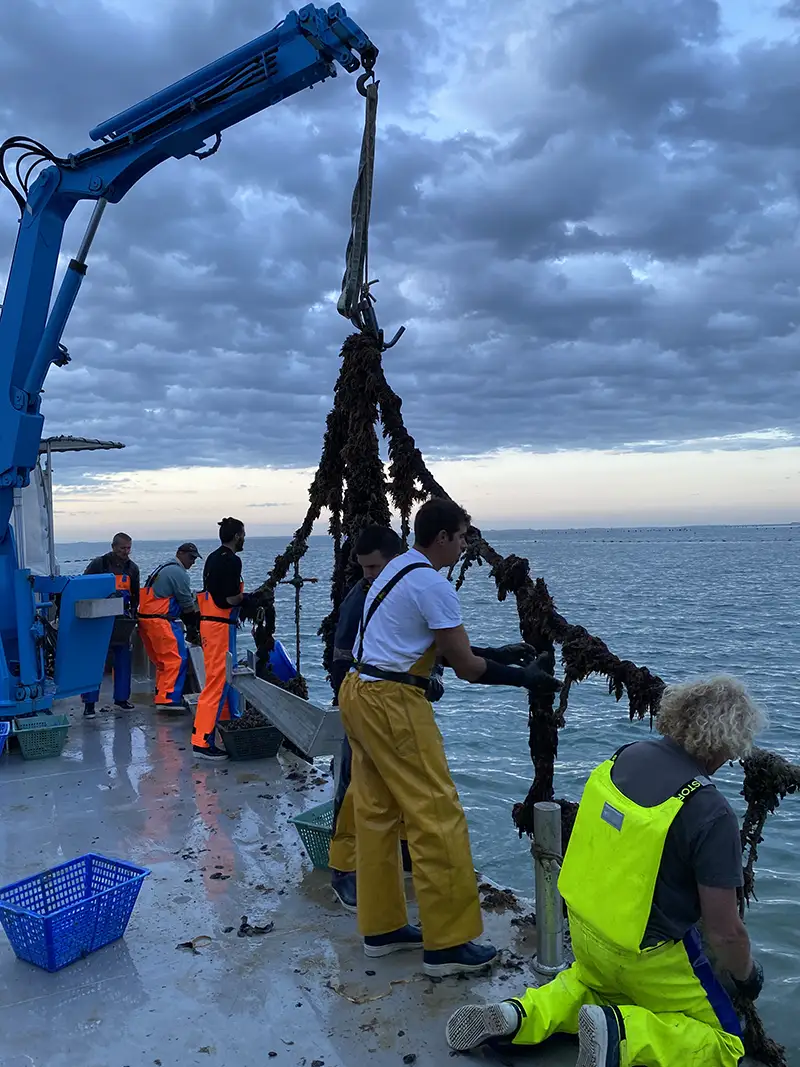
It begins with captage (spat collection), when larvae attach themselves to natural fiber ropes (coconut fiber) set out at sea around March–April. In July, these ropes, now covered with young mussels (spat), are cut into sections and wrapped around the bouchot posts, which have just been harvested after a year of growth. As they develop, the mussel spat forms a thick layer around the post. The ones on the outer surface grow faster than those closer to the post.
When the posts become heavily loaded, we harvest some of the spat to prevent clumps from being torn off by strong swells, and also to control the mussel density on the post.
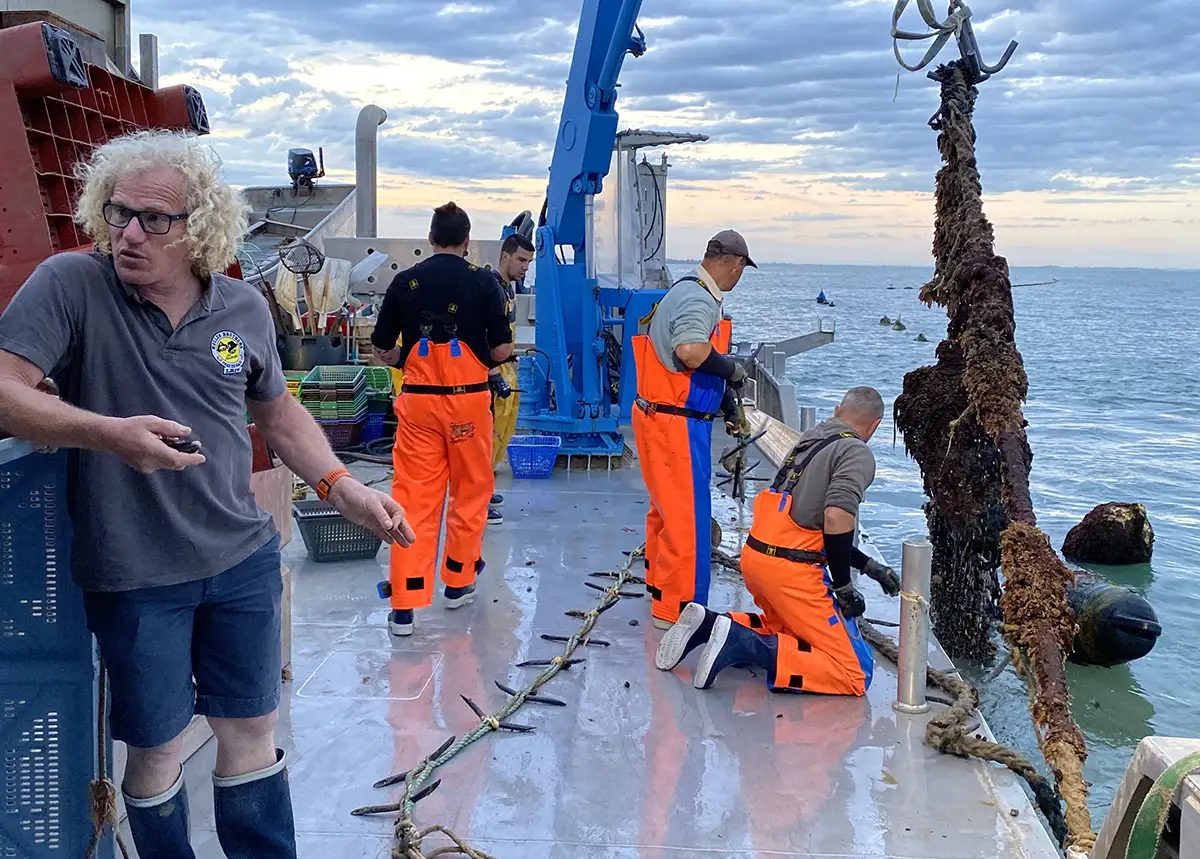
At this stage, we carry out the ‘boudinage’ operation: the young mussels (nouvelains) are placed inside a tubular net. This “sausage” is then wrapped around the post. The mussels push through the net and attach themselves; the stronger ones develop on the outside of the post. The posts must then be thinned out again until all individuals have grown properly.
The mussels develop throughout the following winter and spring.
Seaweed is regularly removed, and predator invasions are closely monitored.
After a year on the bouchot, the mussels are mechanically harvested by boat, then washed, sorted, and packed for shipping and sale. Our floating facilities are EU-approved for shellfish dispatch immediately after harvest: optimal freshness guaranteed!
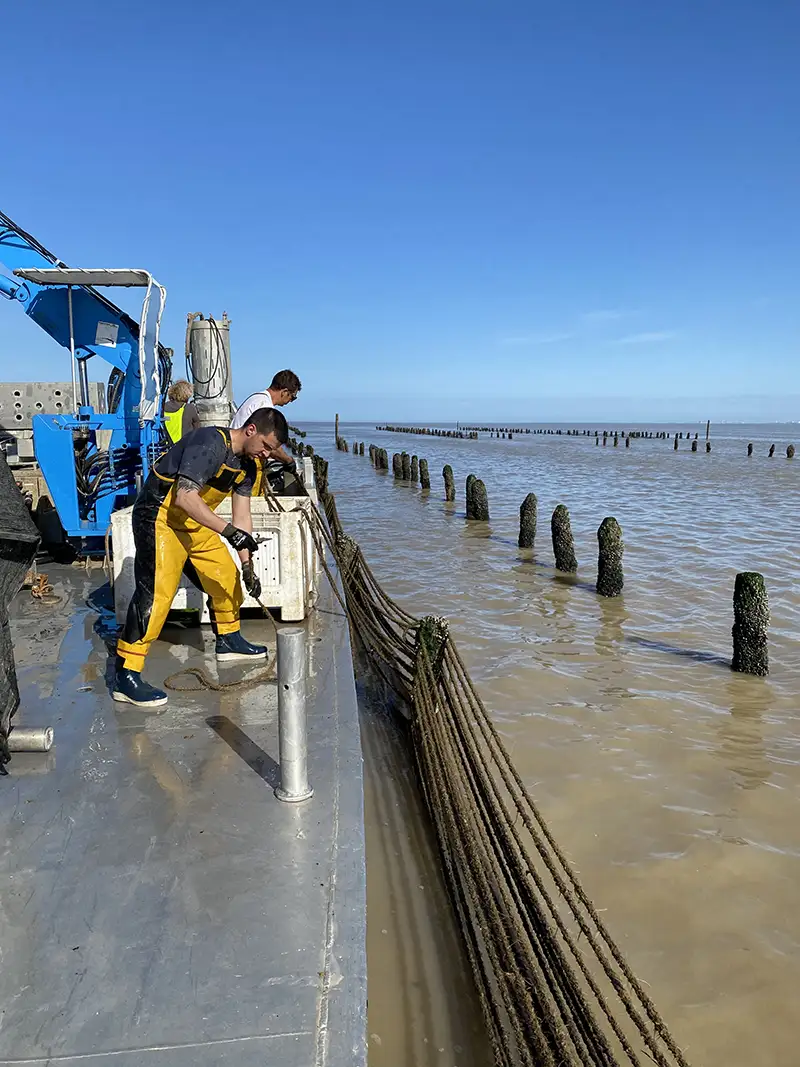
Storms naturally destroy old posts. Each winter, we replace the missing ones to maintain a total of 100 posts per 50-meter bouchot. A hole is drilled into the sand using a water lance, and the post is slid down along it. Once the operation is completed, the lance is removed and the sand naturally fills back in.”
You also farm rope-grown mussels. How do they differ from bouchot mussels?
Benoît:
“Compared to bouchot mussels, rope-grown mussels are raised in the open sea and remain permanently underwater. As a result, they feed continuously and grow more quickly. They also have a black shell with yellow and blue highlights and are slightly larger in size (around 6 cm), with a deeper flesh color. Finally, since they remain permanently underwater, they also have the distinctive feature of a very pronounced iodized flavor.”
Mussel farming is a tough and physically demanding job. What drives and motivates you every day?
Benoît:
“Even though many tools help us today, it’s still a physical job that requires courage and perseverance. But the essential thing is passion. With François, we are driven by that passion. We’re lucky to have an endless horizon as our office, to wake up each morning with the moon setting and the sun rising, while being our own bosses, free to shape our daily lives!”
Mussels: delicious, 100% natural
🗨️ Our great-grandparents, pioneers of mussel farming, used to advise buying mussels “from when the wheat is ripe until the first frosts…”.
Mussels are a seasonal product, so what is the best time to eat them?
Benoît:
“Like any product that nature or the sea gives us, it is essential to respect seasonality, which guarantees quality and optimal flavor. Our bouchot mussels, CHARRON and FORT BOYARD, are harvested when the flesh rate exceeds 24%, from June through November. Rope-grown mussels (moules de filières) are harvested in May, June, and July.”
Where can we meet you and enjoy your delicious mussels?
“Every season, starting in May, we open our hut at the fishing port of Chef de Baie. It’s the perfect occasion to sit down and enjoy the peak mussel season, but also to taste oysters and other fresh, seasonal shellfish, served with bread, butter, and the inevitable glass of white wine! Seated on the terrace with a view of the port and its little fishing boats, we welcome our guests every weekday at lunchtime. And beyond delighting them, what we love most is being there with them to share our craft and our passion.”
Do you have any particular memory of a shared moment with a client over the years?
Benoît: "Every season, there are so many wonderful shared moments. But, there's one that stands out as it particularly moved us. A few years ago, for Christmas, a customer brought us a gift: a metal piece, a kind of trophy, that he had forged himself, representing the Moules Brothers logo. We had met this customer one day at that small village market and had warmed up to him and offered to take him to the tide. So we forged a very special bond."
Benoît and François’ top picks
Baby Beach on Aix Island
On the Northeast of Aix Island, Baby Beach is off-limits for swimming due to dangerous rocks. But with its Mediterranean cove-like feel, surrounded by lush vegetation, this stunning and peaceful beach is the perfect spot to relax and recharge.
Restaurant La Grand Rive in La Rochelle
We love the warm, welcoming atmosphere of this restaurant, as well as its seasonal cuisine and delicious fresh fish dishes. Here, you can enjoy local products while taking in an exceptional view of La Rochelle’s Old Port.
Port du Plomb, between L’Houmeau and Nieul-sur-Mer
North of La Rochelle, Port du Plomb is a charming, almost hidden spot. Once a fishing and oyster-farming harbor, today it remains a peaceful little port for leisure boats. The sea view from the jetty, with its red-and-white beacon tower, is truly beautiful.
5th Generation in the DURIVAUD line of mussel farmers
Portraits of Benoît and François
A hundred years ago, Henri Durivaud, the great-grandfather of Benoît and François, drove his first bouchot posts into the Bay of Aiguillon. Since then, although equipment has evolved to ease the harsh working conditions of seafaring professions, the manual techniques of mussel farming have been handed down from father to son for five generations.
Today, Benoît and François carry on the family tradition of boucholeurs. They manage 20 km of identified concessions, use posts from sustainably managed forests, control mussel density on posts, rely on natural seeding, harvest continuously, minimize the use of plastics, and reuse worn-out posts. The two brothers remain true to the spirit of “peasants of the sea,” while also honoring the local terroir and its people, and placing a strong emphasis on rigorous and environmentally respectful management.
Benoît and François are committed to offering carefully selected mussels—the kind they themselves want to eat! Their bouchot mussels, certified under the Conformité Produit (CCP) label, guarantee quality to consumers in many respects: origin, complete traceability from spat collection to harvest, and a minimum guaranteed flesh content.
Thematic

Written by
Alison Boissard